How Do AI Receptionists Work? The 2026 UK Guide
How do AI receptionists work? They listen, think, and act on a phone call the way a good receptionist would — except they pick up at 3am, never put anyone on hold, and cost a fraction of a salary.
I run eight AI agents on my own business, so this is the inside story, not a sales page.
Watch the video tutorial below, then I will walk you through the exact call pipeline, the real numbers, and the honest limits.
My own setup is 289 automated emails, 8 agents, 20 cron jobs, and one Dell laptop.
So this is how AI receptionists work when they are built properly — the process, the tech, and where they fall over.

How Do AI Receptionists Work — Table Of Contents
- How Do AI Receptionists Work — The Short Answer
- How Do AI Receptionists Work — The 5-Step Call Pipeline
- How Do AI Receptionists Work — Under The Hood
- How Do AI Receptionists Work — What It Books, Answers And Qualifies
- How Do AI Receptionists Work — The Handoff To A Human
- How Do AI Receptionists Work — The Real Numbers
- How Do AI Receptionists Work — What It Costs
- How Do AI Receptionists Work — What It Won't Do
- How Do AI Receptionists Work — FAQ
- How Do AI Receptionists Work — The Bottom Line
How Do AI Receptionists Work — The Short Answer
An AI receptionist is software that answers your business phone, understands what the caller wants, and takes action.
It connects to your phone number, your calendar, and your customer records.
A call comes in.
The AI greets the caller by name if it can.
It listens to what they say in their own words.
It checks the answers you approved — your services, prices, opening hours, policies.
Then it does the job: answers the question, books the appointment, captures the lead, or transfers the call to you with a summary.
That is how AI receptionists work at the simplest level.
The magic is in the pipeline, so let me show you the exact steps.
Want this answering your phone instead of reading about it?
See The AI Suite Store → aisuitehq.org/storeHow Do AI Receptionists Work — The 5-Step Call Pipeline
Every call an AI receptionist takes runs through the same five steps.
Industry documentation from Nextiva describes the process clearly, and this matches what we build for clients.
Step one is the greeting.
The AI answers with your customised greeting, usually within one ring.
Step two is intent.
The AI works out why the caller is phoning by analysing their words and asking follow-up questions when it needs more detail.
This is the big difference from an old phone tree.
An IVR makes you press 1 for sales, 2 for support.
An AI receptionist understands open-ended speech — a caller can say "I need a quote for a leaking boiler" and the AI knows exactly what that means.
Step three is the knowledge base check.
The AI looks up approved information about your services, hours, locations and policies.
It only ever answers from what you loaded, which is the safety net that stops it making things up.
Step four is the action.
It answers the question, takes a message, captures the lead, or books the appointment into your live calendar.
Step five is the record and escalate.
It logs the call details, writes a summary, and transfers complex or sensitive requests to the right person — with full context, so the caller never repeats themselves.
Five steps, a few seconds each.
That is how AI receptionists work on every single call.
How Do AI Receptionists Work — Under The Hood
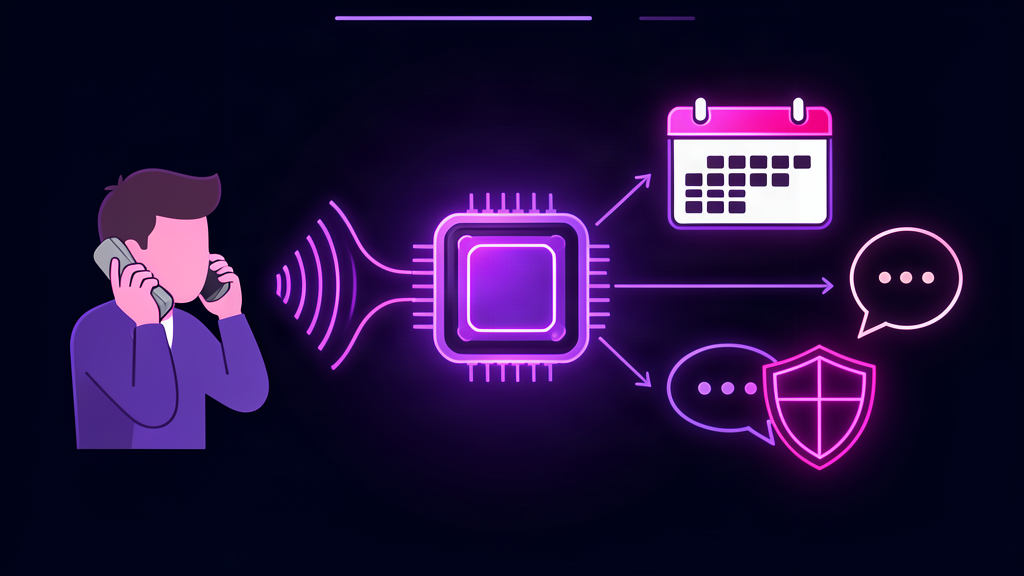
Underneath, an AI receptionist is three machines working together in real time.
The first is speech recognition.
It turns the caller's voice into text as they speak.
The second is the language model.
It reads that text, works out the intent, and decides the response using your knowledge base.
The third is speech synthesis.
It turns the response back into a natural-sounding voice.
Modern systems do all three in under a second, which is why the conversation feels normal.
The voice breathes, pauses, and holds natural conversation.
This is the part that surprises people most — callers genuinely cannot always tell.
The integrations matter just as much as the voice.
The AI connects to your calendar to check real availability before it books.
It connects to your CRM to log the lead and pull up existing customer history.
It can send SMS confirmations and reminders after the call.
This is where most DIY setups fail, by the way.
On Reddit, builders repeatedly report the same headache: the AI works fine on the phone, then falls over integrating with calendars and CRMs.
That is exactly why we build the integrations as part of the setup rather than leaving them to the client.
RingCentral's AI receptionist documentation makes the same point — the AI learns your services, policies and processes, and keeps improving with every conversation.
More calls, better answers.
That is how AI receptionists work under the hood — done-for-you agents from £99 → aisuitehq.org/store
How Do AI Receptionists Work — What It Books, Answers And Qualifies
Let me make this concrete with the jobs it actually does.
Booking is the big one.
The AI checks your live calendar, offers the caller the open slots, and books the job into the diary.
One heating engineer we work with recovered two boiler replacements worth £4,800 in his first week with a £99 a month agent.
Answering comes second.
It handles the questions you get ten times a day: prices, opening hours, service areas, whether you do emergency call-outs.
Qualifying comes third.
It asks the two or three questions that separate a real job from a tyre-kicker — what the problem is, where the property is, when they need it done.
Then it hands you a qualified lead instead of a voicemail.
Following up comes fourth.
Missed callers get a text within minutes.
Quotes that went quiet get a nudge on day seven.
Every one of those jobs is a job a receptionist used to do, done 24 hours a day.
A plumber we work with was losing £1,200 a month in missed calls before the agent went live.
He now recovers £6,000 to £8,000 a month on a £99 retainer.
Those are real deployments, not marketing numbers.
How Do AI Receptionists Work — The Handoff To A Human
The honest answer to how AI receptionists work includes the handoff.
The AI does not handle everything.
It should not.
Reddit users who run these systems say the same thing: the best results come from a hybrid approach.
The AI handles routine calls, after-hours calls, and unexpected overflow.
When a caller asks for a person, or the request falls outside what the AI is set up to handle, it transfers to a human — seamlessly.
The person on the other end gets a summary of the whole conversation.
The caller does not repeat themselves.
That detail is what stops customers feeling like they are talking to a robot.
The common criticism on forums is that AI cannot catch tone or frustration.
That is true.
Which is exactly why the escalation rules matter.
Anything involving money, a complaint, or an unusual request should go to a human.
We run every agent we build with that rule: routine work stays with the AI, big decisions come to you.
Our own AI Profit Playbook walks through how to set those escalation rules so the handoff is invisible to the customer.
Want the handoff rules set up properly the first time?
Get It Built Right → aisuitehq.org/storeHow Do AI Receptionists Work — The Real Numbers
Now the numbers, because you should not buy this on vibes.
McKinsey's research on customer care found that around 70% of Gen Z customers prefer to call when they cannot resolve an issue another way.
Younger customers still pick up the phone.
RingCentral publishes real customer results for its AI receptionist.
Televero Health reported a 97% CSAT score since rolling it out.
Iron Workers International said 60% of member calls were resolved completely by the AI.
Axis Integrated Mental Health projected $1.7 million in additional revenue from the same setup.
Three different businesses, three different industries, same pattern.
The AI absorbs the routine volume and the humans handle the edge cases.
Our own numbers are smaller but real.
289 automated emails a day.
8 agents running on one laptop.
20 cron jobs.
One plumber recovering £6,000 to £8,000 a month on a £99 retainer.
That is how AI receptionists work in practice: they answer everything, resolve the routine, and hand you the qualified work.
How Do AI Receptionists Work — What It Costs
Cost depends on whether you DIY it or have it built for you.
DIY tools start around £25 to £97 a month.
You do the setup, the training, and the integrations yourself.
Nextiva's own XBert starts at $99 a month for 100 interactions, with usage billed after that.
Done-for-you UK services run £99 to £399 a month depending on how many workflows the agent runs.
That compares with £32,000 to £42,000 a year for a full-time human receptionist in the UK.
One year of a human receptionist pays for about 30 years of an AI agent.
The hidden costs are what you have to watch.
Some agencies charge £2,000 to £10,000 just to build the agent.
Some charge per-minute call fees on top of the monthly price.
Ask for one flat monthly price with setup included.
That is how we price it: agents from £99 a month, setup included, 30-day guarantee — see the full stack → aisuitehq.org/store.
If you want the full breakdown, our AI receptionist cost guide has every number.
⚡ Stop losing leads to voicemail. AI receptionist set up for you, from £99 → aisuitehq.org/store
Done-for-you AI receptionist, live in 48 hours, £99/month.
Book Your Setup CallHow Do AI Receptionists Work — What It Won't Do
Now the part nobody else will tell you.
An AI receptionist cannot read frustration in a voice the way a trained human can.
It cannot handle a genuine complaint with empathy and judgment.
It cannot negotiate a price or talk a furious customer down.
It will make mistakes if the knowledge base is wrong.
It will make mistakes if the escalation rules are badly set.
That is not a reason to avoid it.
It is a reason to set it up properly.
Feed it good answers and strict escalation rules, and it handles 80% of calls perfectly while you take the 20% that matter.
The businesses that complain about AI receptionists are almost always the ones that bought a tool and skipped the training.
The businesses that love them built the knowledge base like they were training a new hire.
That is the whole secret.
For the full list of failure modes and how to stop them, read our honest breakdown of whether AI agents can make mistakes.
⚡ Missed calls are costing you jobs. Fix it this week → aisuitehq.org/store
How Do AI Receptionists Work — FAQ
How do AI receptionists work?
An AI receptionist answers your calls, understands what the caller wants using natural language processing, checks your approved knowledge base, then takes an action like answering a question, booking an appointment or capturing a lead. When a caller wants a human, it transfers the call with full context. It connects to your phone number, calendar and CRM, and works 24/7.
Can an AI receptionist book appointments into my calendar?
Yes. The AI checks your live calendar for availability, offers the caller the open slots, and books the appointment directly into your scheduling platform. It can also send text confirmations and reminders, which cuts no-shows. This is the single highest-value job it does for tradesmen.
What happens when a caller wants to speak to a human?
The AI transfers the call to a person on your team, and the person receives a summary of the conversation so the caller does not have to repeat themselves. The best setups run hybrid: the AI handles routine and after-hours calls, and escalates anything sensitive or complicated to a human.
Will an AI receptionist sound robotic?
Modern voice AI sounds natural — it breathes, pauses and holds a real conversation. It understands open-ended speech and follow-up questions, unlike old phone trees. The limits are not the voice; they are the knowledge base behind it. If the training data is good, the calls sound human.
How much does an AI receptionist cost in the UK?
DIY AI receptionist tools start around £25 to £97 per month. Done-for-you UK services run £99 to £399 per month depending on how many workflows the agent runs. AI Suite builds done-for-you receptionist agents from £99 per month with setup included and a 30-day guarantee.
How long does it take to set up an AI receptionist?
A simple version can answer calls within a day. A properly trained one — with your services, prices, opening hours and booking rules loaded — takes about 48 hours to set up and test. The training data is what separates a receptionist that books jobs from one that just answers.
Do AI receptionists make mistakes?
They make mistakes when the knowledge base is wrong or the escalation rules are badly set. The fix is guardrails: the AI handles routine questions, bookings and FAQs on its own, and anything involving money, complaints or unusual requests gets handed to a human. That is how we run every agent we build.
How Do AI Receptionists Work — The Bottom Line
Here is where I land after running these systems for real clients.
How do AI receptionists work?
They answer every call, understand it, act on it, and hand you the work that needs a human.
The tech is not the hard part anymore.
The hard part is the knowledge base and the escalation rules — the stuff most people skip.
Skip it and you get a robot that annoys your customers.
Do it properly and you get a receptionist that never misses, never sleeps, and books jobs while you are on the roof.
That is how AI receptionists work when they work.
And that is the version we build.
Start with the free AI setup checklist, or see the AI Suite store — and if you want the whole thing done for you, book a setup call and we will have your agent answering calls within 48 hours.
Your AI receptionist, live in 48 hours, £99/month.
Start Today → aisuitehq.org/storeRelated reading
How Much Does An AI Receptionist Cost? Can AI Replace A Receptionist? What Is An AI Phone Answering Service? Is An AI Receptionist Cheaper Than A Human? AI Agent vs Receptionist How To Stop Missing Customer EnquiriesLatest Updates