How To Automate Quote Follow Ups — The 2026 System That Books Jobs While You Work
Stop chasing quotes. Start booking jobs. I show you the exact AI sequence, the timings, and the words that work.
Get It Built For You →How to automate quote follow ups — how many quotes did you send last month that just died in silence?
Watch the video tutorial below, then steal the exact system I use: AI agents that chase quotes by email, book the jobs, and bring dead enquiries back to life.
How To Automate Quote Follow Ups — Table Of Contents
- How To Automate Quote Follow Ups — Why Most Quotes Die In Silence
- How To Automate Quote Follow Ups — The 24-48-4-7 Cadence
- How To Automate Quote Follow Ups — The AI Agent Way
- How To Automate Quote Follow Ups — What The Sequence Looks Like
- How To Automate Quote Follow Ups — What To Write
- How To Automate Quote Follow Ups — The Tools That Do It
- How To Automate Quote Follow Ups — Mistakes That Kill The Win
- How To Automate Quote Follow Ups — FAQs
How To Automate Quote Follow Ups — Why Most Quotes Die In Silence
I run AI Suite from a single Dell laptop that cost me £450 on eBay.
I've got 8 AI agents running 20 cron jobs, processing 289 emails a week, and one of the most valuable jobs they do is chasing quotes.
Here's the pattern I see in every trade I work with: you visit the job, you price it up, you send the quote, and then you wait.
And wait.
And wait.
Then nothing.
It is not normal for a customer to book from one quote sent into the void.
Homeowners routinely collect three to five quotes for every job, so your quote is sat on a kitchen counter next to two or three competitors.
That alone is why learning how to automate quote follow ups matters more in 2026 than cutting your price.
Because here is the stat that changed how I think about quoting: 78% of customers buy from the first business that responds to them, according to the Lead Response Management Study.
Not the cheapest. The first to respond.
And most tradesmen never respond at all.
They send the quote and they wait for the phone to ring.
Your competitors are not winning because they are cheaper.
They are winning because they follow up and you do not.
So if you want to know how to automate quote follow ups, the first thing to accept is this: the follow up is where the job is won, and it is a system, not a personality trait.
How To Automate Quote Follow Ups — The 24-48-4-7 Cadence
Before we talk about AI, let's nail the manual system, because automation just executes a plan you already understand.
The follow up cadence that works, backed by field service software company Housecall Pro, looks like this:
- First follow up: 24-48 hours after sending the quote, while the customer is still looking at it.
- Second follow up: 4-5 days later, offering a tweak, a question, or a better date.
- Final nudge: 1 week after that, using your calendar filling up as the reason to touch base.
That is the 24-48-4-7 cadence, and it strikes the balance between persistent and pushy.
Reach out too soon and you look desperate.
Wait too long and your quote is forgotten under the pile of three other quotes.
Here is the wider truth about persistence: 80% of sales require five or more follow-up attempts, yet 44% of salespeople give up after a single one, a stat popularised by Marketing Donut.
Most tradesmen are not even giving it one follow up, so a three-touch sequence already puts you ahead of the field.
Speed matters just as much as the number of touches.
The first contractor to send a professional estimate wins the job roughly half the time, even when they are not the cheapest, according to service industry data from WorkZen.
Their numbers are brutal: respond within an hour and you close over 60% of quotes, send it next day and you drop to 20-25%, wait four days and you are below 5%.
So if you are sending quotes days after the visit, you are not losing on price.
You are losing on time.
That is exactly why you need to know how to automate quote follow ups: a machine never forgets the timing.
How To Automate Quote Follow Ups — The AI Agent Way
Now let's talk about the part that changes everything: an AI agent doing the chasing for you.
I do not have a receptionist.
I do not have a virtual assistant.
I have agents.
One of them watches my inbox, and when a quote goes out, the follow up clock starts ticking automatically.
Here is how I explain it to tradesmen who think this is complicated: you teach the agent the cadence above, you give it your voice, and it sends the messages on the right days while you are up a ladder.
When a customer replies, the agent flags it, books the job, or passes it to you if it needs a human.
One heating engineer in Stockport paid £697 for a one-off agent build and pulled in £4,800 of work in week one, most of it from quotes that would have died in the void.
An electrician in Leeds closed 11 jobs in his first month after switching to automated follow ups — £7,200 of work from quotes he used to send and forget.
A plumbing client on our £99 a month retainer recovers £6,000-£8,000 a month of work she was losing, and she saves about 20 hours a week that used to go into chasing.
None of these people are techies.
They are tradespeople who finally learned how to automate quote follow ups and let the machine do the awkward part.
The awkward part is the reason it works.
Customers go quiet because they are busy, not because they hate you.
A polite, helpful message that lands on day two puts your name back on the kitchen counter.
An AI agent never feels awkward.
It never gets distracted by a job on site.
It never thinks "I'll do it later."
Want the exact stack? Every agent, workflow and cron job I run is packaged in the AI Suite blueprint — including the quote chaser.
Get The AI Suite Blueprint →How To Automate Quote Follow Ups — What The Sequence Looks Like
Let me walk you through the exact sequence so you can picture it running while you work.
Here is what the system does the moment you send a quote:
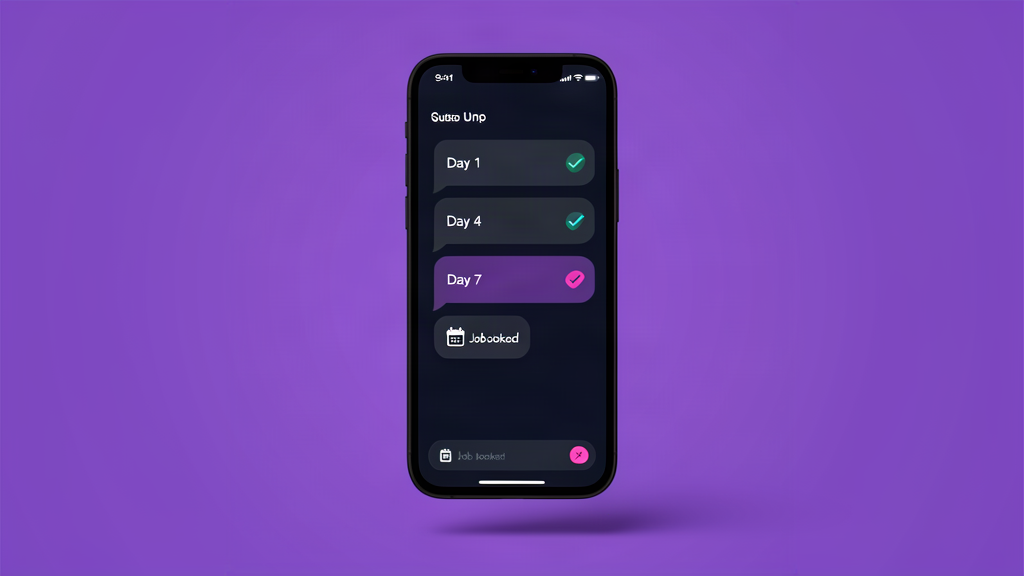
Day 0 — the quote goes out and the agent logs it in the tracker with the follow up dates already set.
Day 1-2 — the agent sends the first follow up: short, helpful, no begging.
Day 4-5 — the agent sends the second touch, offering to adjust the quote or checking if anything changed.
Day 7 — the agent sends the final nudge, using your availability as the reason.
If the customer replies, the agent reads the reply and either books the job, answers the question, or hands it to you with a summary.
If the customer says the price is the problem, the agent comes back to you with that feedback, because that information is gold for your pricing.
If nobody replies after the third touch, the agent files the lead with a note and moves on.
No guilt.
No wasted energy.
No more lying in bed wondering which quote is still alive.
Data from Count.co shows quotes followed up within 24 hours see 20-30% higher close rates, and automated sequences with personalised touchpoints at 3, 7 and 14 days outperform one-off messages.
That matches what I see in my own inbox every single week.
And once the job is booked, the same agent can send the confirmation, the reminder, the invoice, and the review request.
One system, running the whole customer journey.
That is how to automate quote follow ups without turning your life into a spreadsheet.
How To Automate Quote Follow Ups — What To Write
People overthink the words.
The message does not need to be clever.
It needs to be short, helpful, and easy to reply to.
Housecall Pro's guidance is spot on: keep follow up emails to two to four sentences, avoid the words "just checking in," and never ask why they haven't replied.
Here are the three messages I use, and you can steal them word for word:
First follow up (day 1-2): "Hi [name], just making sure you got my quote for the [job]. Happy to go through it if you have any questions — I can tweak anything on there. Cheers, [you]"
Second follow up (day 4-5): "Hi [name], no rush at all, but I wanted to check if anything changed with the [job]. If the quote needs adjusting, tell me what you had in mind and I'll sort it today. [you]"
Final nudge (day 7): "Hi [name], my diary for [month] is filling up fast, so if you want the [job] done before [date], let me know this week and I'll hold a slot for you. If you've gone elsewhere, no worries — just say the word. [you]"
See what those messages do?
They give the customer a reason to reply.
The first one offers help.
The second one offers flexibility.
The third one offers a deadline that is real.
Every one of them is built for a yes, a no, or a counter-offer, and every one of them is easy for an AI agent to send in your voice.
That is the whole game when you automate quote follow ups: keep it human, keep it short, keep it on schedule.
How To Automate Quote Follow Ups — The Tools That Do It
You have three ways to automate quote follow ups, and they cost very different amounts of effort.
Option one is a spreadsheet with reminders, and I will be honest with you: it works until the day you forget to update it.
Tradesmen tell me all the time that their tracking sheet becomes "just another place to forget to update."
Option two is a ready-made tool with built-in quote follow ups, like a CRM or field service app.
They work, but most of them are built for American service businesses, priced in dollars, and still need you to write the messages.
Option three is an AI email agent built around your actual inbox, which is what we do at AI Suite.
The agent watches your sent folder, tracks every quote, sends the sequence on schedule, and handles the replies.
You stay in your normal email.
No new dashboard to babysit.
No subscription to a system that does not fit how a UK trade business actually runs.
If you want the done-for-you version, the AI Suite store has the quote chaser agent and the full blueprint, our AI quote follow up agent for tradesmen handles the whole sequence in your voice, and our setup service builds it around your business in a day.
If you want to understand the bigger picture first, my guide on AI agents for tradesmen covers the whole stack, and how to use AI for invoicing shows the same agent chasing payment after the job is done.
The tools are not the hard part.
The hard part is deciding that chasing quotes is a system, not a chore.
How To Automate Quote Follow Ups — Mistakes That Kill The Win
I have watched tradesmen make the same mistakes for years, and they all cost jobs.
Here is what kills the win:
Waiting too long.
The quote that arrives three days after the visit loses to the one that arrived three hours after.
Speed is the cheapest marketing you will ever buy.
Being vague.
"Just following up" is the weakest sentence in business.
Give the customer a reason to reply or do not send it.
Giving up after one attempt.
Remember: 44% of salespeople quit after one try, and 80% of sales need five or more.
The job is usually won on touch two or three.
Quoting everyone.
Count.co found qualified leads convert 3-5 times higher than unqualified ones, so qualify before you price.
Ask the budget, the timeline, and who decides before you spend an hour on a quote.
Ignoring the no.
When a customer picks someone else, that feedback is worth its weight in gold.
An automated reply that asks "what made you go elsewhere?" will tell you exactly why you are losing.
And the biggest mistake of all: treating follow ups as something you will do when things are quiet.
Things are never quiet.
That is why you automate.
How To Automate Quote Follow Ups — FAQs
How to automate quote follow ups without sounding pushy?
Automate quote follow ups with a fixed cadence of short, helpful messages: one at 24-48 hours, one at day four or five, and a final nudge at day seven. Each message offers value — a question, a tweak, or a date — instead of begging for a reply. An AI agent sends these on schedule while you stay on the tools.
How many times should you follow up on a quote?
Follow up on a quote at least three times over 7-10 days. Studies show 80% of sales need five or more follow-up attempts, yet 44% of salespeople give up after one. Most tradesmen never follow up at all, so a simple three-touch sequence already puts you ahead of most of your competition.
How soon should you follow up after sending a quote?
Follow up within 24-48 hours of sending the quote. Most customers look at quotes within a day or two, and research shows the first contractor to send a professional quote wins the job around half the time. Quotes followed up within 24 hours see 20-30% higher close rates.
Can AI agents really chase quotes for me?
Yes. An AI email agent can track every quote you send, log the follow-up dates, write and send the follow-up messages, and flag anyone who replies for your attention. At AI Suite we run 8 agents on 20 cron jobs processing 289 emails a week from one laptop, and quote chasing is one of the highest-value jobs we automate.
What is the best way to automate quote follow ups for tradesmen?
The best way to automate quote follow ups for tradesmen is an AI agent connected to your inbox and calendar: it sends the quote, schedules the follow-ups, books the job when the customer says yes, and reminds you who to call. You can build this yourself from the AI Suite store, or book a setup and we build it for you.
How much does it cost to automate quote follow ups?
A DIY AI agent for quote follow ups costs roughly £30-£100 a month in tools, or one setup fee if you buy a ready-built kit. Agencies charge £5,000-£15,000 for a single AI agent setup; our most expensive one-off is £697, and our retainers start at £99 a month. One recovered job usually pays for the whole year. Check the pricing page for the current list.
How To Automate Quote Follow Ups — Ready To Stop Losing Jobs To Silence?
The jobs you are losing are not going to cheaper competitors.
They are going to the tradesman who followed up.
Every quote you send today is a bet, and the follow up is the only thing that decides who wins it.
You can keep sending quotes into the void, or you can automate quote follow ups and let the machine chase every single one.
Start with the free AI readiness checklist, grab the blueprint, or get the whole thing built for you.
And if you want the full picture of where this fits, read how to get more leads for my trade business and how to never miss a call on site next.
Automate quote follow ups once, and you will never chase a quote by hand again.
Done chasing quotes by hand? Get the exact AI sequence built around your inbox — quotes chased, jobs booked, while you work.
See The Kits →